Day of the Week Calculator
Find Any Day of the Week
Discover what day of the week any date in history falls on. Whether you’re planning an event, researching historical dates, or just curious, this calculator will give you the answer instantly using Day of the Week Calculator
How to use:
- Select a date using the date picker or type it in (MM/DD/YYYY format)
- Click “Calculate Day” to find the day of the week
- View additional information about the date
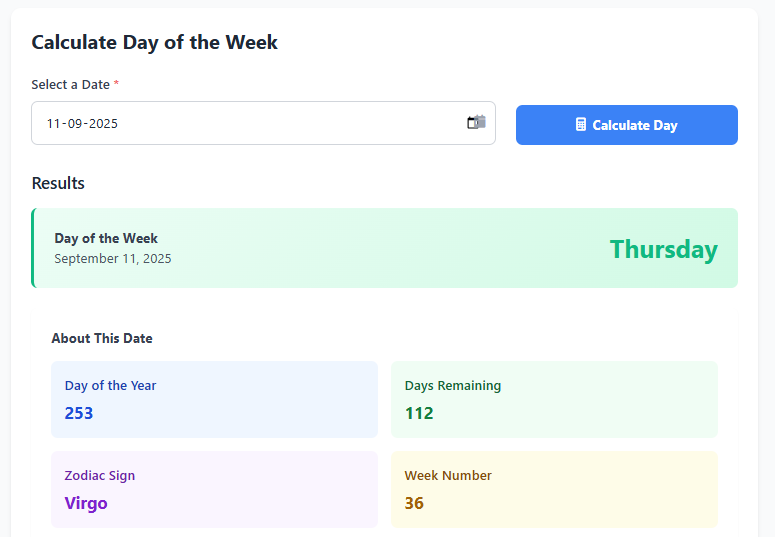
Calculate Day of the Week
Results
Day of the Week
September 10, 2023
About This Date
Day of the Year
253
Days Remaining
112
Zodiac Sign
Virgo
Week Number
36
Did You Know?
September 10th is National Sewing Machine Day. The first sewing machine was patented by Elias Howe in 1846.
Days of the Week
Monday
Moon’s Day
Tuesday
Tiw’s Day
Wednesday
Odin’s Day
Thursday
Thor’s Day
Friday
Frigg’s Day
Saturday
Saturn’s Day
Sunday
Sun’s Day
Famous Historical Dates
July 20, 1969
First humans landed on the Moon (Saturday)
November 9, 1989
Fall of the Berlin Wall (Thursday)
January 1, 2000
Beginning of the 21st Century (Saturday)
December 17, 1903
First powered flight by Wright Brothers (Thursday)
Day of the Week Calculator : Your Time-Traveling Calendar
Have you ever wondered what day of the week your birthday will be next year? Or maybe you’re curious about what day a big historical event happened, like the first moon landing? Figuring out the day for any date in history or the future can feel like a super tricky math problem. Luckily, a Day of the Week Calculator is like a time machine for your calendar! This clever tool instantly tells you the weekday for any date you choose.
First, it’s important to know that our calendar follows a repeating pattern, but it’s not simple. For example, leap years add an extra day, and months have different lengths. Therefore, calculating the day manually involves complicated formulas. A Day of the Week Calculator handles all this hard work for you, so you get the answer in a flash.
Day of the Week Calculator : How It Works
So, how does a Day of the Week Calculator perform its magic? Actually, it uses a special algorithm that mathematicians created. This formula considers all the calendar rules, including leap years and the different days in each month.
- Enter Your Date: First, you type the date you’re curious about into the tool. For instance, you might enter your birth date or a future holiday.
- Click Calculate: Next, you press the “Calculate” button.
- Get Your Answer: Then, the tool processes the date through its algorithm. After that, it instantly displays the correct day of the week!
Consequently, you discover that July 20, 1969, was a Sunday (the moon landing!), or you can plan ahead for next year’s birthday. As a result, you satisfy your curiosity without any stress.
Why It’s a Fun and Useful Tool
This amazing tool is helpful for many awesome reasons. Mainly, it makes planning events and activities much easier. Additionally, it’s perfect for school projects about history or for solving calendar puzzles. Moreover, it’s a fun way to impress your friends with your knowledge of dates!
For Planning, Learning, and Discovering
You can use a Day of the Week Calculator to plan a party on a convenient weekend day, learn about the timing of historical events, or simply answer those “I wonder what day that was?” questions.
Day of the Week Calculator : Unlock the Calendar’s Secrets
You should use a Day of the Week Calculator whenever you have a question about a date. It turns a complex calendar mystery into a simple, easy answer. Remember, time is full of fascinating patterns, and this tool helps you explore them all.
In conclusion, a day of the week calculator is a fascinating tool that answers your questions about past and future dates. Ultimately, it helps you plan smarter, learn more about history, and see the calendar in a whole new way.
Frequently Asked Questions of Day of the Week Calculator
Q1: How does a historical day of the week calculator determine weekdays for ancient dates?
A1: A historical day of the week calculator uses algorithmic formulas like Zeller’s Congruence; however, it must account for calendar changes like the Gregorian transition. Therefore, it cross-references historical date systems, and consequently, it provides accurate results even for centuries-old dates.
Q2: Can a future date calculator account for leap years and calendar adjustments?
A2: Yes, a future date calculator automatically incorporates leap years and all known calendar rules. For example, it factors in the 400-year cycle of the Gregorian calendar, so it ensures precision for dates decades or even centuries from now.
Q3: Why should I use a birthday day calculator instead of a regular calendar?
A3: A birthday day calculator saves time and eliminates manual errors. While calendars require counting days manually, this tool automates the process instantly. Moreover, it can calculate weekdays for any year, past or future, which standard calendars often don’t display easily.
Q4: Is a day of the week finder accurate for dates before the 20th century?
A4: Absolutely! A day of the week finder relies on mathematical algorithms validated by historians and astronomers. However, for very ancient dates, it may note historical calendar variations, but it still delivers highly reliable results for most practical purposes.
(FAQs)Day of the Week Calculator
Q5: How can a pregnancy due date calculator help expectant parents plan?
A5: A pregnancy due date calculator estimates the likely day of the week for birth. First, it calculates from the last menstrual period or conception date. Then, it helps parents schedule appointments and prepare, so they can organize their time more effectively.
Q6: Can a business day calculator exclude weekends and holidays?
A6: Definitely! A business day calculator often allows custom settings. For instance, you can input regional holidays and select which days count as weekends. After that, it calculates only working days, which is crucial for project timelines and deadlines.
Q7: How does a retroactive date calculator verify past weekdays?
A7: A retroactive date calculator cross-references multiple algorithmic systems. First, it applies formulas like Doomsday or Conway’s Method. Then, it checks against historical records for validation, and therefore, it ensures accuracy for verified past events.